
AI
AI on the Plant Floor: What Actually Changes in a Maintenance Shift
September 28, 2026
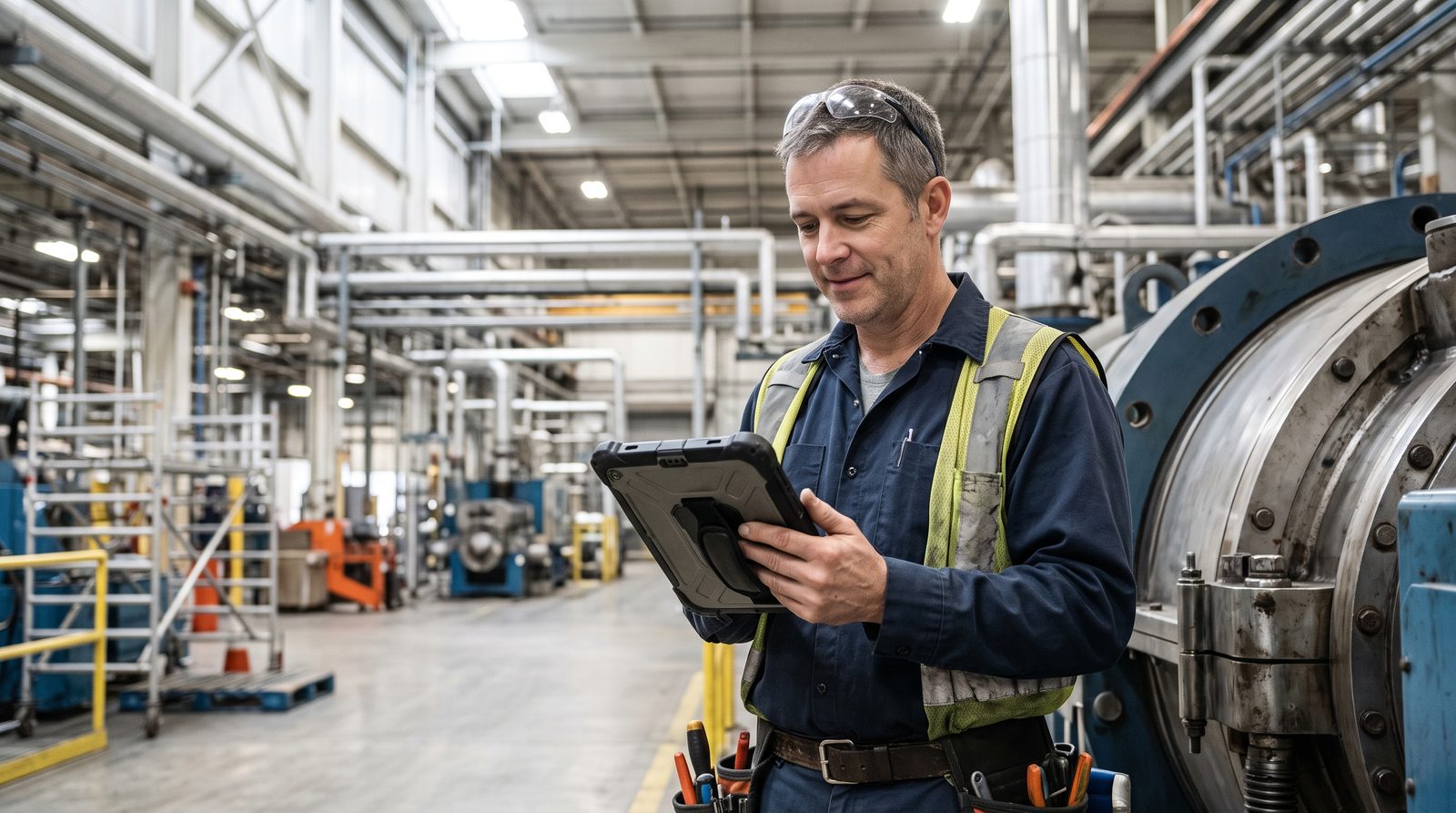
Not robots, and not a dashboard nobody opens. The useful AI in a plant shows up in the small frictions of a maintenance shift — the fault nobody recognizes, the part nobody can find, the history nobody has time to read. Here is what it looks like hour by hour.
Ask most people what AI looks like in a factory and they will describe a robot arm, or a screen full of predictive-maintenance charts. Both exist. Neither is where the value has landed for the maintenance teams we work with.
What has actually changed is smaller and more useful: the twenty minutes a technician loses looking for something that was already written down. A plant generates an enormous amount of text — work order long texts, operation confirmations, inspection notes, shift handovers — and almost none of it is ever read again. It is written once, filed, and effectively lost. AI is good at exactly that shape of problem.
Here is what it looks like across a shift.
Start of shift: the handover you can actually query
A supervisor arrives and needs to know what happened overnight. Traditionally that is a conversation, a whiteboard, and a stack of notifications nobody has time to open.
The change is not a new dashboard. It is being able to ask, in plain language, what went wrong on line 3 last night, and did anyone fix it — and getting an answer assembled from the actual notifications and confirmations, with the record numbers attached so it can be checked.
That last part matters more than the answer. An assistant that produces a confident paragraph with nothing behind it is worse than useless on a plant floor, because it will eventually be wrong and nobody will know which time. An assistant that says "three notifications, here they are" can be verified in seconds.
The round: less typing, same rigour
Operator rounds and inspections are where paper dies hardest. Someone walks a route, reads gauges, checks tolerances, and writes it down — then types it in later, from memory, at the end of a shift.
The useful AI here is unglamorous. It is transcribing a spoken note while someone's hands are dirty. It is reading a gauge or a nameplate from a photo instead of asking for it to be keyed in. It is noticing that a reading sits outside tolerance and raising the notification itself rather than waiting for someone to remember.
None of that is impressive in a demo. All of it removes a reason not to record something properly, and the quality of everything downstream depends on that record existing.
The unfamiliar fault: the real win
This is where it earns its place.
A technician meets a fault they have not seen before. The person who has seen it is on another shift, or retired last year. The information exists — buried in a work order from four years ago, described in someone else's words, in a system with no useful search.
Being able to ask has this happened before on this equipment, and what fixed it is the single most valuable thing AI does in a plant. It is not prediction. It is retrieval of institutional memory that was technically always available and practically never accessible.
The workforce context makes this sharper. Experienced maintenance people are retiring faster than they are being replaced, and a lot of what they know was never written down anywhere except in the notes they left on work orders. Those notes are the asset. Most plants are sitting on decades of them.
Finding the part
A job stops for a part as often as it stops for a diagnosis. The classic failure is not that stock is missing — it is that nobody can tell whether it is in stock, at which storeroom, under which of four descriptions somebody typed over the years.
Matching a described part to the material master is a language problem, and language problems are what these models are for. "The blue seal on the No. 2 pump" and SEAL,O-RING,VITON,75MM are the same object; a keyword search will never connect them.
Closing the job: where the time actually goes
Ask a maintenance technician what they like least and it is rarely the work. It is the paperwork after the work — the confirmation, the hours, the long text describing what was done.
Turning a short spoken account into a properly structured confirmation is a good use of a model, with one hard rule: a person approves it before it is posted. The system of record stays the system of record. On one recent rollout we watched several hundred work orders close this way over a few weeks, with the hours posting straight through to SAP and none rejected — which is the only metric that matters, because a confirmation that bounces costs more time than it saved.
What has not changed
Being straight about the limits is the difference between a tool people use and a tool people work around.
It does not predict failures from maintenance text. Genuine predictive maintenance needs sensor data, history, and a real model. Language models read what people wrote; they do not know what a bearing is about to do. If a vendor is blurring those two things, be careful.
It is wrong sometimes. Everything consequential needs a person in the loop and a visible source. Read-only by default, approval before anything is posted, and an audit trail that shows what the model saw.
Bad data stays bad. If confirmations are empty and long texts say "fixed", there is nothing to retrieve. AI makes good records more valuable; it does not create them. Plants with a strong recording culture get dramatically more out of this than plants without one, which is an uncomfortable finding but a consistent one.
Connectivity is still the constraint. Plants have dead zones, and the failure mode people remember is the one that happened when they were standing in it. Anything that only works with a live connection will be distrusted after the first time it fails at the wrong moment.
Adoption is the hard part, not the model. The most common reason a rollout stalls has nothing to do with AI. Someone's account is set up wrong and their job list comes back empty, so they quietly go back to the old way — and from the outside it looks like resistance. It is worth checking the boring explanation first.
Where to start
If you are looking at this seriously, the order that has worked is:
- Make the history searchable before anything else. Retrieval over maintenance records is the lowest-risk, highest-value starting point, and it needs no new hardware.
- Pick one round or one inspection and remove the double entry. Narrow scope, measurable result.
- Keep every answer sourced. If it cannot show the records behind it, it will not be trusted, and trust is the whole game.
- Only then look at prediction. It is real, but it needs sensor data and a longer runway — and it is much easier to justify once the first three have proved themselves.
The plants getting value from AI are not the ones that bought the most ambitious thing. They are the ones that picked a daily annoyance, removed it properly, and moved on to the next.
VectorVue builds maintenance and inspection software for plant teams, including an assistant that answers from your own maintenance history. If you want to talk through what this would look like on your floor, get in touch.
Have a project like this? Talk to our team →