
Compliance
France Has Said Au Revoir to PDF Invoices
May 2, 2025
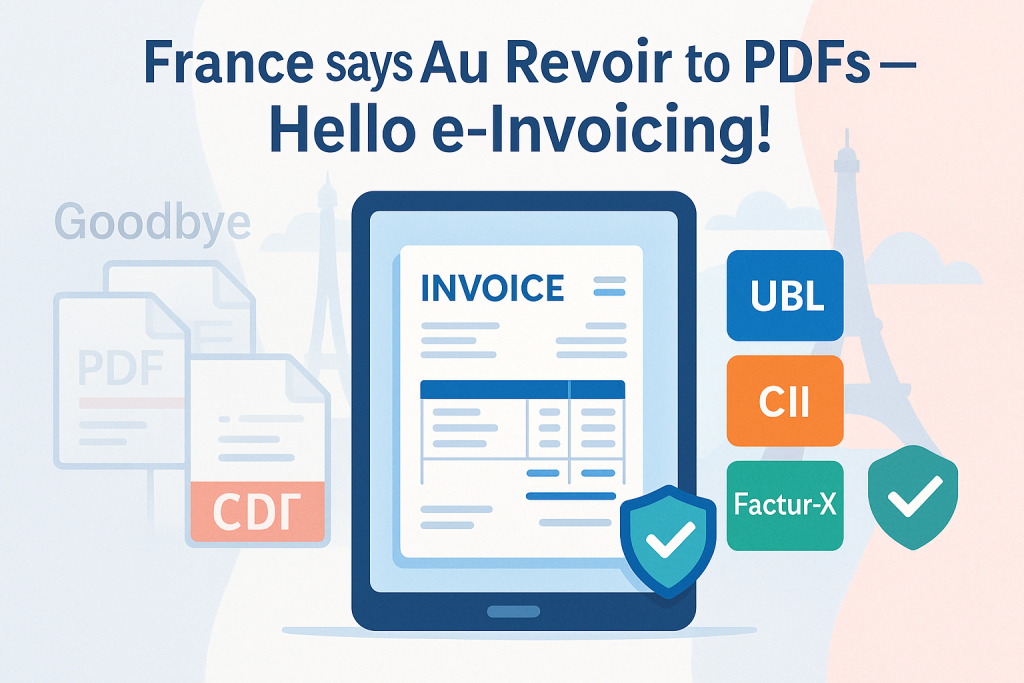
Since 1 September 2026, every VAT-registered business in France must be able to receive electronic invoices, and larger companies must issue them. SMEs follow on 1 September 2027. Here is where the reform stands and what is still left to do.
France's e-invoicing reform is no longer something to prepare for. The first deadline has passed, and it changed how every VAT-registered business sends and receives invoices.
Where things stand
Since 1 September 2026:
- Every VAT-registered business must be able to receive electronic invoices. There is no size exemption on the receiving side — if you have a French VAT registration, this already applies to you.
- Large and mid-sized companies must also issue electronic invoices and submit the associated e-reporting.
The next date is 1 September 2027, when SMEs and micro-enterprises must also issue electronic invoices and meet the e-reporting obligations. If you are in that group, you are receiving electronic invoices today and have under a year to be ready to send them.
The terminology changed too
What was originally called a Partner Dematerialization Platform (PDP) is now a Plateforme Agréée (PA) — an approved platform. If you are reading older guidance, or an internal project document written before the change, expect to see the PDP label; it refers to the same thing.
This matters more than a naming tidy-up, because routing an invoice through an approved platform is not optional. Invoices cannot simply be emailed between trading partners.
What the reform actually requires
- Structured formats, not PDFs. Factur-X, UBL and CII — a PDF attached to an email is no longer a compliant invoice, however neat it looks.
- An approved platform (PA). Invoices flow through one, in both directions.
- Reporting to the tax authority. Invoice and transaction data goes to the DGFiP, not just to your customer.
- E-reporting on top of e-invoicing if you sell to consumers, trade internationally, or work in sectors with additional requirements such as construction.
The obligation that catches people out is the receiving side. A business that issues very few invoices still has to accept them electronically, which means being registered on a platform and being findable in the directory — even if nothing ever leaves the building.
The upside
It is a genuine compliance burden, but it is not only cost:
- Pre-filled VAT returns
- Faster, more predictable payment cycles
- Real-time visibility of what has been billed and received
- Stronger fraud prevention across the system
If you are not ready
For the September 2027 group the remaining work is not large, but it is not nothing either:
- Confirm you can receive, properly — not just that an invoice arrives, but that it reaches your ERP and posts without someone rekeying it.
- Choose your approved platform and understand what it does and does not do for you.
- Fix your master data before you automate around it. Incorrect SIRET numbers and VAT identifiers are the single most common reason an invoice is rejected, and that problem is far cheaper to solve now than in production.
- Map the e-reporting obligations that apply to your transactions, which is where the requirements differ most between businesses.
At VectorVue we help businesses meet these requirements: selecting an approved platform, designing compliant invoice workflows, and integrating the whole thing with SAP or whichever ERP you run — so compliance is something your finance team can live with rather than work around.
The dates and obligations above reflect the reform as it currently stands. French requirements have been revised more than once, so confirm the detail that applies to your business with your tax adviser before acting on it.
Have a project like this? Talk to our team →